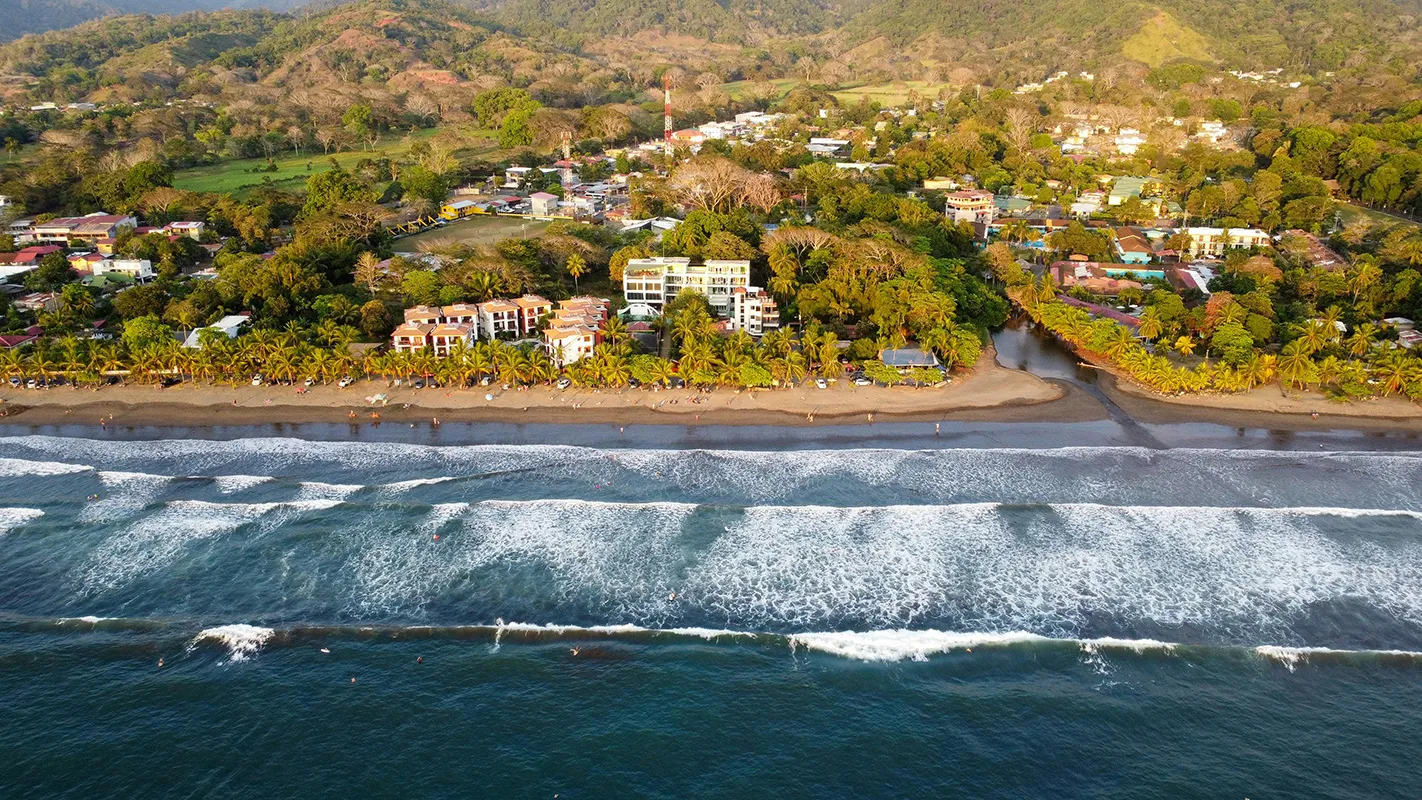

Costa Rica's beaches attract builders worldwide. The rules for building near them are complex - not because the laws are bad, but because too many institutions overlap and each has its own process.
Before buying land or hiring an architect, you need to know which institutions regulate coastal construction, what each requires, and the most common mistakes. Above all: Costa Rica's beaches belong to the Costa Rican people. No one has the right to privatize them, fence them, or obstruct them.
Beaches Belong to the People: Public Access is Non-Negotiable
The Constitution and the ZMT Law guarantee free access. Any obstruction is illegal.
Under Article 50 of the Political Constitution of Costa Rica and Law No. 6043 on the Maritime Terrestrial Zone (ZMT), the first 200 meters from the ordinary high tide line on both coasts are public domain. This means:
- No posts, fences, or barriers may obstruct access to the beach
- No private furniture, structures, or installations may occupy the public zone without proper concession
- No surveillance or security measures may impede the free passage of citizens
- The Municipalities have the constitutional obligation to protect and guarantee this access
Costa Rican environmental lawyers have repeatedly stated that the Sala Constitucional has been hardening coastal protection in recent years. In November 2025, environmental lawyers filed a constitutional action against regulations of the Papagayo Tourist Pole that violated environmental protection standards. The Sala IV admitted the action, demonstrating that the Court is actively monitoring coastal development.
1. The Maritime Terrestrial Zone (ZMT): The Starting Point
Start here. Do not buy coastal property without understanding the ZMT first.
The Law No. 6043 on the Maritime Terrestrial Zone defines that the first 200 meters from the ordinary high tide line on both coasts of the country are public domain. This applies to the entire Pacific and entire Caribbean, regardless of whether the land looks private or someone swears they have title.
In the restricted zone, the only legal way to use the land is through a concession granted by the Municipality, which must be registered in the General Registry of ZMT Concessions of the National Registry. Without that registration, there are no rights to protect.
| Strip | Distance | Can you build? | Base requirement |
|---|---|---|---|
| Public zone | 0 - 50 m | Forbidden | None - absolute public domain |
| Restricted zone | 50 - 200 m | Only with concession | Municipal concession registered in National Registry |
| Private zone | + 200 m | Yes, with normal permits | Municipal permit + CFIA + institutions |
| Base law: ZMT Law No. 6043 · Regulation Decree 7841-P · Amendment Decree 37882 | |||
2. Current Problems on Costa Rica's Coasts
Illegal construction, moratoriums, and the fight between development and protection.
Costa Rica's coasts face a permanent tension between economic development and environmental protection. In 2025-2026, several critical issues have emerged:
In June 2025, the Legislative Assembly approved the waiver of committee procedure for a bill (Expediente 24.937) that would double the moratorium period for demolitions and evictions in the ZMT from 4 to 8 years. The bill, presented by Deputy Carolina Delgado Ramírez, aims to give coastal municipalities more time to complete their regulatory plans.
However, the Congressional Technical Services Department warned that the bill has several legal and technical weaknesses:
- The explanatory statement does not explain why previous deadlines were not met
- There is no data on how many coastal cantons have actually advanced their regulatory plans since 2014
- Restarting the deadline from the new law's effective date could generate legal insecurity
- The measure would reactivate a regime of legal tolerance toward coastal occupations
Municipalities across Costa Rica have intensified demolitions of illegal structures in the ZMT. The Constitutional Chamber's November 2025 ruling against the Municipality of Osa set a precedent: municipalities must act, not just promise to act. The ruling gave the municipality 4 months to:
- Inspect the beach
- Process and definitively resolve the complaint
- Adopt necessary measures to enforce the law
3. The Institutions: Who Controls What
A coastal project may require up to 8 different institutional approvals.
Coastal construction in Costa Rica requires approvals from multiple institutions. Each one can stop your project. Knowing what each requires before you start saves months and thousands of dollars.
It is the entry point to any construction permit in the country. All plans must bear the signature and seal of a registered professional. The digital CFIA APC platform centralizes review by the Ministry of Health, Firefighters, and AyA in a single file.
Issues the declaration of tourist or non-tourist aptitude of the coastal zone. Approves coastal regulatory plans in coordination with INVU. Without that declaration, the municipality cannot approve construction works in the ZMT.
Administers the Environmental Impact Assessment (EIA) process. Hotels, condominiums, and tourist developments require prior environmental viability. Most small projects (under 500 m²) are exempt but must comply with the Code of Good Environmental Practices.
Issues water availability letters. In coastal areas without sewer networks, the project must include an approved septic solution. Local ASADAS can fulfill this role in small coastal communities.
Endorses plans verifying compliance with sanitation, safety, and hygiene standards of the Construction Regulations. Grants operating permits for tourist and commercial coastal establishments.
Reviews fire protection requirements on the APC platform. Applies to hotels, cabins, restaurants, condominiums, and any public occupancy use in coastal zones, regardless of size.
Property law updates, building regulations, and real estate tips for Costa Rica. Monthly, free.
Controls construction in or adjacent to national parks, refuges, and coastal reserves. In turtle nesting zones, establishes additional restrictions on lighting and nighttime access.
SENASA (National Animal Health Service of MAG) does not directly regulate coastal residential or tourist construction. It appears in coastal regulatory plans as a technical reference in the glossary, but its competence is animal health and livestock control, not building permits.
Pura Vida Insider Newsletter — Building on Beaches
ZMT law, CFIA, ICT, SETENA rules, and what you must know before building near Costa Rica's public beaches.
We respect your privacy. Unsubscribe anytime.
4. The Process: How to Do It Correctly
Follow this order. Skipping steps adds months.
- Verify the legal status of the land - Confirm in the National Registry that the ZMT concession exists, is current, registered, and up to date with the municipal canon. If there is no approved coastal regulatory plan in that area, the process stops here.
- Land use study and alignments - Request from the municipality the land use certificate, MOPT alignments if facing a national route, INVU alignments if there are rivers or streams, ICE alignments if there are power lines.
- Environmental viability (SETENA) - For projects that require it, process the resolution before starting construction plans. Requires CRTM05 coordinates and evaluation of setbacks from water bodies and protection areas.
- SINAC technical criterion - If the property borders a protected wild area, obtain this criterion before advancing with the design.
- Design and endorsement on CFIA APC platform - The licensed professional enters the plans in digital format. The system coordinates parallel review by the Ministry of Health, Firefighters, AyA, and CFIA itself.
- ICT endorsement for ZMT - Submit endorsed plans to ICT for approval in the maritime terrestrial zone. ICT puts the municipality on notice.
- Municipal construction permit - With all previous endorsements complete, the municipality issues the construction permit. This is the last step before starting work.
- Water availability letter (AyA/ASADA) - Can be processed in parallel with steps 4-6. Essential before the final municipal permit.
5. Institutional Comparison Table
What each institution does and requires.
| Institution | Law / Legal basis | Role in coastal construction | Key requirement | Mandatory? |
|---|---|---|---|---|
| ZMT Law | Law No. 6043 + Decree 7841-P | Defines the 50m public and 150m restricted strips | Concession registered in National Registry | Essential base |
| CFIA | Organic Law No. 3663 | Endorses plans and registers responsible professionals | Plans on APC platform with collegiate signature | Always mandatory |
| ICT | Law No. 6043 Art. 15 | Tourist declaration + approves coastal regulatory plan | Declaration + ZMT plan endorsement | Always in ZMT |
| INVU | Urban Planning Law | Urban control where there is no regulatory plan | River, stream, aquifer alignments | If applicable to land |
| SETENA | Environment Organic Law No. 7554 | Environmental Impact Assessment (EIA) | Environmental viability resolution | By project category |
| AyA / ASADA | AyA Law No. 2726 | Water availability and sanitation | Water availability letter | Always mandatory |
| Ministry of Health | Construction Regulations | Sanitary plan endorsement | Approval on APC platform | Always mandatory |
| Firefighters | Meritorious Body Law | Human safety and fire protection | Review on APC platform | Public use mandatory |
| Municipality | General Urbanism Law | Final construction permit + ZMT administration | All previous endorsements complete | Always mandatory |
| SINAC / MINAE | Biodiversity Law No. 7788 | Technical criterion in protected wild areas | Binding technical criterion | If borders ASP |
| Sources: Law No. 6043, Decree 7841-P, Decree 37882, CFIA Organic Law No. 3663, AyA Law No. 2726, Environment Organic Law No. 7554, regulations in force as of May 23, 2026. | ||||
6. Eco-Architecture in Coastal Zones: What Professionals Recommend
Building on the coast means designing for salt, heat, and storms - not just checking legal boxes.
The CFIA leads the Blue Ecological Flag - Sustainable Construction Category (BAECS) program, the most relevant voluntary certification for sustainable construction in Costa Rica. In coastal zones, the challenge is not just complying with the law but designing for an environment of high temperature, extreme humidity, salinity, and intense rains.
North-south orientation to take advantage of sea breezes. Eliminates or reduces air conditioning use.
In coastal zones with constant winds (Guanacaste), wind complements solar panels during the night.
Fundamental on the Pacific coast where the dry season can be very prolonged.
Reuse for irrigation. In areas without sewer networks, it is also a Ministry of Health requirement.
Bamboo, local stone, wood certified by MINAE. Costa Rica has the INTE C170 RESET standard for sustainable tropical construction.
Reduce the building's thermal load. The INTE C170 RESET standard and Expediente 25.040 promote them in new sustainable projects.
- BAECS (CFIA) - Blue Ecological Flag Sustainable Construction Category. The most relevant at the national level.
- LEED - International (USGBC). Projects like Escazú Village already have this certification in Costa Rica.
- EDGE - IFC (World Bank) certification for efficient buildings in emerging markets.
Environmental lawyers in Costa Rica confirm the Constitutional Chamber is enforcing coastal protection harder now. Three principles to understand before investing:
- Coastal public domain is imprescriptible. It does not matter how many years a construction has been there, if it is in the public zone it can be demolished.
- The nullity of illegal permits does not validate the work. A municipal permit improperly granted (without regulatory plan, without valid concession) is null by full right. The work built under that permit can also be ordered demolished.
- Environmental complaints do not prescribe in the same way. Environmental damage has different treatment from civil damage. An illegal construction in a mangrove area or protected area can have criminal consequences decades later.
7. Final Summary: What You Cannot Ignore
The five points that matter most.
Sources: Law on the Maritime Terrestrial Zone No. 6043 (1977) and Regulation Decree 7841-P; Executive Decree 37882-MP-H-TUR (Canon, Areas and ZMT Setbacks); CFIA Organic Law No. 3663; INVU Construction Regulations (2022 update); ICT Plan Endorsement Regulations in ZMT; Environment Organic Law No. 7554 (SETENA); Costa Rican Legal Information System (SCIJ); CFIA Magazine June 2024 (BAECS); Century21 Costa Rica, CICSA CR and GeoCosta Rica - 2025-2026 procedure data. Additional sources: La Nación - "Sentencia exige poner orden en conocida playa de Costa Rica" (November 29, 2025); Semanario Universidad - "Sala IV estudia acción contra normas de Polo Turístico Papagayo" (November 17, 2025); Delfino.cr - "Otra Asamblea, otra pateada de bola: dispensan de trámite ley para prorrogar moratoria de desalojos en Zona Marítimo Terrestre" (June 2, 2025); Congressional Technical Services Report on Expediente 24.937; Constitutional Chamber Ruling on Playa Dominical, Osa (November 2025); SINAC / MINAE - Protected Area regulations; Law 9577 (moratorium suspension until 2027). All deadlines and costs are reference estimates. Always verify with competent institutions.
Enjoyed this article? Read more on our Blog ?